
Bearing Failure Diagnostic Guide

How To Identify A Bad Wheel Bearing: Noise, Vibration, Heat, And Play

A bad bearing usually announces itself through abnormal noise, rising temperature, vibration, and looseness before it fails completely. This guide covers the classic wheel-bearing roar, the steering and shake tests, motor and HVAC bearing symptoms, and the visual damage patterns that confirm why a bearing failed.

How To Tell If A Bearing Is Failing

Bearings reduce friction between moving parts, whether they are in a wheel hub, electric motor, blower, washing machine, or pulley. When a bearing starts to fail, friction comes back in the form of heat, noise, and vibration, and the damage can spread quickly into shafts, housings, seals, and related components.

Wheel bearings are a common example, but the diagnostic logic is broader than automotive work alone. If a machine suddenly develops a roar, squeal, growl, shake, or hot bearing housing, the same core question applies: is the rolling surface still smooth, lubricated, and properly supported, or is the bearing already breaking down?
Universal Bearing Failure Signs

  • Abnormal noise such as humming, roaring, squealing, clicking, or grinding.
  • Heat buildup that makes the hub or bearing housing noticeably hotter than normal.
  • Vibration or roughness that can be felt through the vehicle, housing, or machine frame.
  • Looseness, wheel play, or shaft movement where the bearing should feel solid.
  • Load- or speed-sensitive noise that changes as machine speed rises or weight shifts.
  • Secondary clues such as ABS warnings, current draw increases, breaker trips, leaking seals, or contamination.

Bad Bearing Identification Diagram

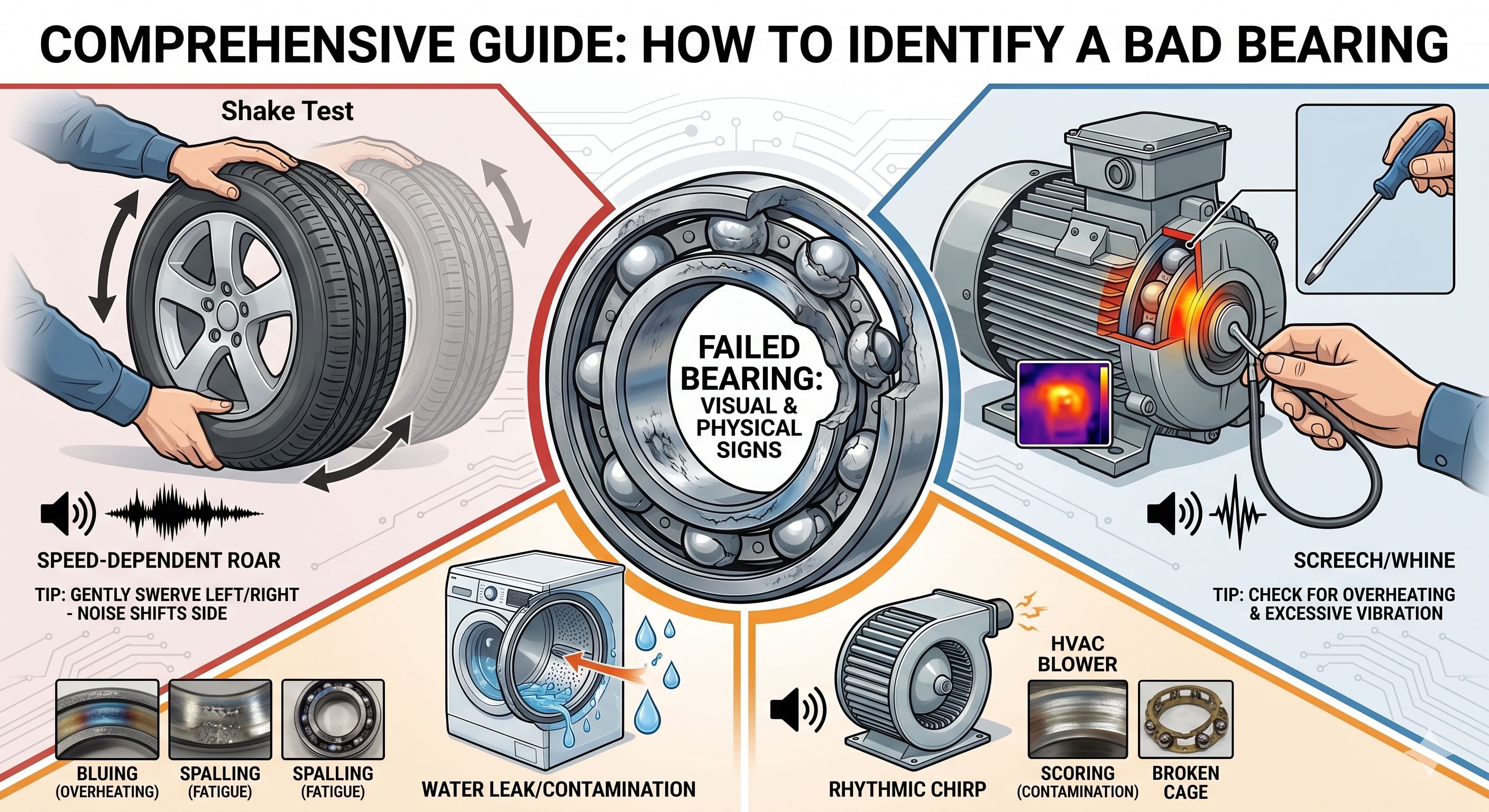
This infographic summarizes the most common checks and failure clues across wheel bearings, motors, blowers, and other equipment.

Infographic showing how to identify a bad bearing with wheel-bearing shake test, motor stethoscope checks, HVAC blower symptoms, and visible failure patterns.
Quick visual guide to bad-bearing diagnosis across automotive, motor, blower, and household applications.

Practical Diagnostic Checks

Start with non-invasive checks like noise, heat, and movement. If the evidence points to the bearing, move to a physical inspection or replacement plan before the damage spreads.

Wheel bearings: road noise, turning, and ABS clues

A bad wheel bearing often sounds like a low helicopter-like hum, rumble, or roar that gets louder with road speed. One of the best real-world checks is the steering test: if the noise gets louder when you turn right, the left bearing is often loaded harder, and vice versa. A severely loose hub can also disturb the wheel-speed signal and trigger ABS or traction-control warnings.

Wheel bearings: the 12-and-6 shake test

Lift the vehicle safely, support it on stands, and grasp the tire at 12 o’clock and 6 o’clock. Rock it in and out while feeling for play or clunking. A healthy wheel bearing should feel solid. If you feel movement, confirm the looseness is not coming from a ball joint or another suspension component before condemning the hub.

Motors and blowers: squeal, growl, heat, and current draw

Motor bearings often fail with a high-pitched squeal when lubrication is drying out or with a gravelly growl once the races are damaged. A screwdriver used as a simple stethoscope can amplify the bearing noise at the housing, and an infrared thermometer can quickly reveal one bearing end running much hotter than the other. In industrial settings, rising amp draw and vibration analysis often confirm the problem before a technician can hear it clearly.

Washers, HVAC blowers, pulleys, and idlers

The same symptoms show up in smaller equipment. A washing machine with a failed tub bearing can sound like a jet engine on spin. A furnace or HVAC blower with dry bearings may chirp or squeak on startup. A seized idler-pulley bearing can make a belt squeal even when the belt itself is not the root problem.

Post-removal inspection: what the damage pattern means

Once the bearing is out, the failure mode usually becomes visible. Spalling or flaking points to fatigue, blue or purple discoloration points to overheating and lubrication loss, scoring suggests contamination, and a broken cage means the bearing was near catastrophic failure. Most premature bearing failures trace back to poor lubrication, contamination, or improper installation and alignment.

Try A Search

Start with exact part numbers, known interchange numbers, or the brand plus part number.

Need Help?

Use part numbers first. Ask for quote help when the fitment, dimensions, or interchange are not clear.

Search by exact part number

Use the catalog when you already have the bearing, seal, or OEM number.

Request alternates or quantity pricing

Use the quote form when you need substitute brands, confirmation, or larger-order pricing.

Need dimensional or application help?

Call 877-929-7280 or include notes and files in the quote request.